Bathroom Lighting Trends 2026: Vanity, Ceiling, and Accent Layers That Work

The best bathroom lighting trends for 2026 are practical: vertical vanity lighting or wide mirror light for faces, dimmable ceiling lighting for cleaning and showers, warm low-level night lighting, wet-rated fixtures where moisture is present, and hidden LED accents under floating vanities or inside niches. Use 3000K to 3500K around the mirror for grooming and 2700K to 3000K for relaxing evening or night scenes.
Bathroom Lighting Trends 2026: Vanity, Ceiling, and Accent Layers That Work
Bathroom lighting trends for 2026 are moving away from one harsh ceiling fixture and toward layered, flattering, adjustable light. The best bathrooms now treat the mirror, shower, ceiling, storage, and nighttime path as different lighting jobs. That sounds more complicated, but it usually produces a calmer room with fewer mistakes: better face light at the vanity, enough brightness for cleaning, and softer light when the bathroom is used late at night.
Quick answer {#quick-answer}
The best bathroom lighting trends for 2026 are vertical vanity lighting or a wide mirror light, dimmable overhead lighting, shower-rated recessed lights where needed, low-level night lighting, hidden LED accents, and better color rendering. Use 3000K to 3500K around the mirror for grooming. Use warmer 2700K to 3000K for evening ambience, bathtub areas, and night scenes. Choose CRI 90+ when possible so skin tones, tile, paint, and makeup look natural.
If you only upgrade one thing, fix the mirror. Overhead-only lighting casts shadows under the eyes, nose, and chin. A pair of vertical sconces at face height, or a wide diffused mirror bar, usually improves the room more than a decorative ceiling fixture.
For whole-home planning, pair this bathroom guide with our [room lighting guide](/blog/room-lighting-guide-color-temperature-lumens-layers) and our [LED color temperature room guide](/blog/led-color-temperature-room-guide-kitchens-bedrooms-workspaces).
Vanity lighting is becoming the main design decision {#vanity-lighting}
The vanity is where bathroom lighting has to be most accurate. People shave, apply makeup, style hair, inspect skin, brush teeth, and start the day in front of the mirror. Trendy bathroom lighting only works if it makes those tasks easier.
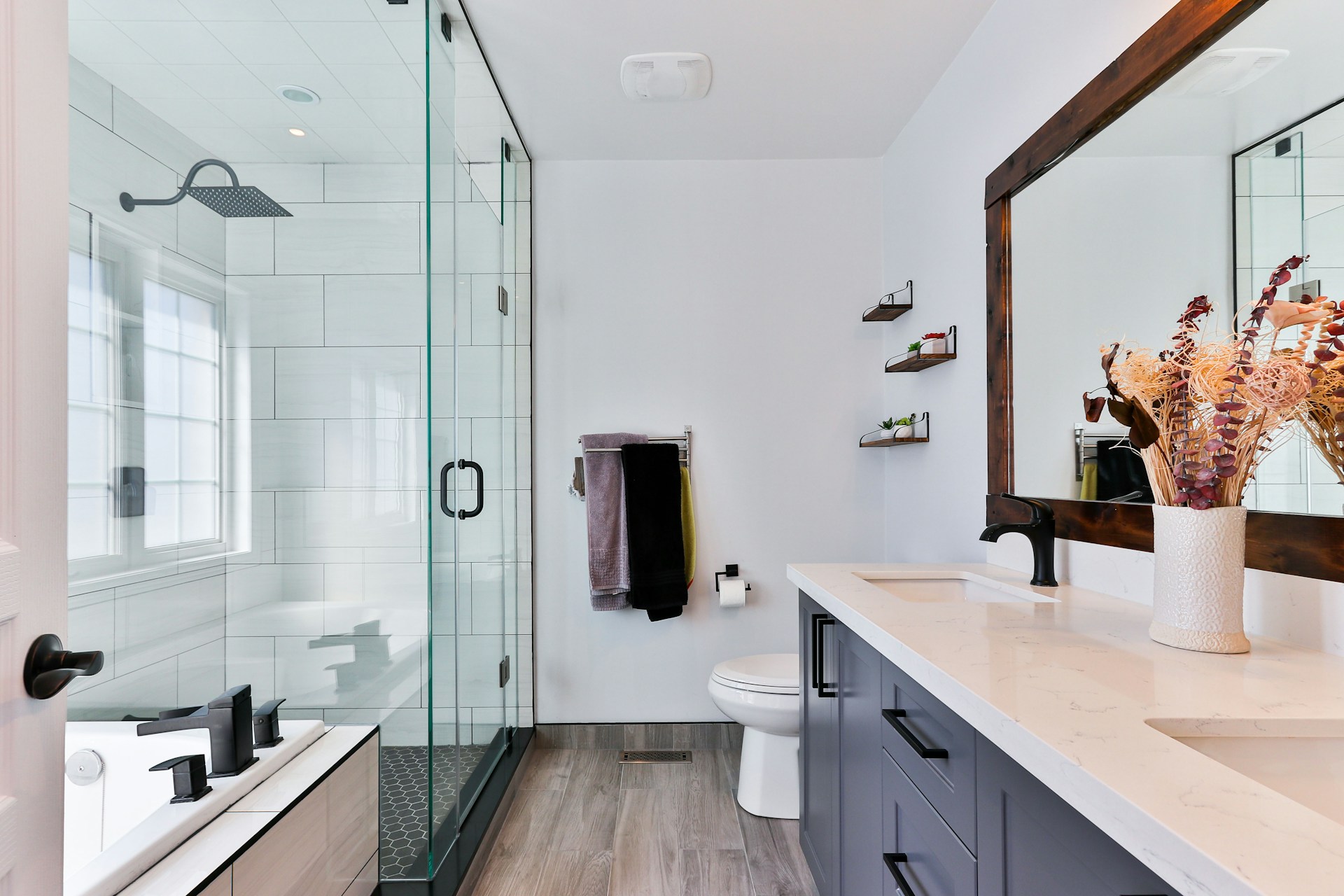
The strongest vanity trend is even face lighting from the sides. Vertical sconces mounted on both sides of the mirror reduce shadows better than a single downlight. When side sconces are not possible, a wide horizontal fixture above the mirror can still work if it is diffused, bright enough, and not mounted so high that it becomes another ceiling light.
Backlit mirrors are popular, but they should not be the only face light unless the mirror is designed to throw enough light forward. Many backlit mirrors create a beautiful wall glow while leaving the face underlit. They are excellent as an accent layer, but they often need a front-facing task layer too.
For double vanities, do not rely on one small fixture in the middle. Use one good fixture per sink, vertical fixtures between and outside mirrors, or a continuous bar that covers the full active mirror zone. The goal is even illumination across both faces, not a bright center and dim outer edges.
Ceiling and shower lighting are getting quieter {#ceiling-shower}
Bathroom ceiling lighting in 2026 is less about statement fixtures and more about clean placement. Recessed lights, low-profile flush mounts, and simple linear fixtures are replacing oversized decorative pieces in many practical bathrooms. The ceiling layer should make the room easy to clean, safe to enter, and bright enough when full light is needed.
A small bathroom may need one central ceiling light plus vanity light. A larger bathroom may need separate zones: vanity, toilet area, shower, tub, and storage. Shower lighting should use fixtures rated for the location. Wet and damp areas are not places to improvise with ordinary decorative fixtures.
The U.S. Department of Energy describes LED lighting as efficient, long-lasting, and highly controllable compared with older lighting technologies: https://www.energy.gov/energysaver/led-lighting. That controllability matters in bathrooms. A dimmable LED ceiling layer can be bright for cleaning in the morning and much lower during evening routines.
Energy Star also notes that LED bulbs use far less energy and last longer than traditional incandescent bulbs: https://www.energystar.gov/products/lighting_fans/light_bulbs/learn_about_led_bulbs. Since bathrooms often use several fixtures in a small footprint, efficient LEDs make layered lighting more practical without meaningfully increasing energy use.
Color temperature is splitting by task {#color-temperature}
The biggest bathroom color-temperature shift is that one Kelvin value no longer has to do every job. Mirror light can be clear and neutral, while bath and nighttime light can be warmer.
For most bathrooms, use this range:
| Bathroom zone | Best color temperature |
|---|---|
| Vanity and grooming | 3000K to 3500K |
| Shower general light | 3000K to 4000K |
| Bathtub and evening ambience | 2700K to 3000K |
| Night lighting | 2200K to 2700K, dimmed |
| Utility or laundry-bath combo | 3500K to 4000K |
Avoid very cool 5000K light in the main bathroom unless the room is intentionally clinical or utility-focused. It can make skin look flat and tile feel cold. On the other hand, very warm 2200K to 2400K light is usually too amber for the mirror. It is better as a dim night path or spa scene than as everyday grooming light.
Color rendering is just as important as color temperature. Choose CRI 90+ for vanity fixtures when possible. A cheap low-CRI bulb can make makeup, hair color, stone, grout, paint, and skin tones look off even if the Kelvin number is technically correct.
Accent lighting and night lighting are no longer afterthoughts {#accent-night}
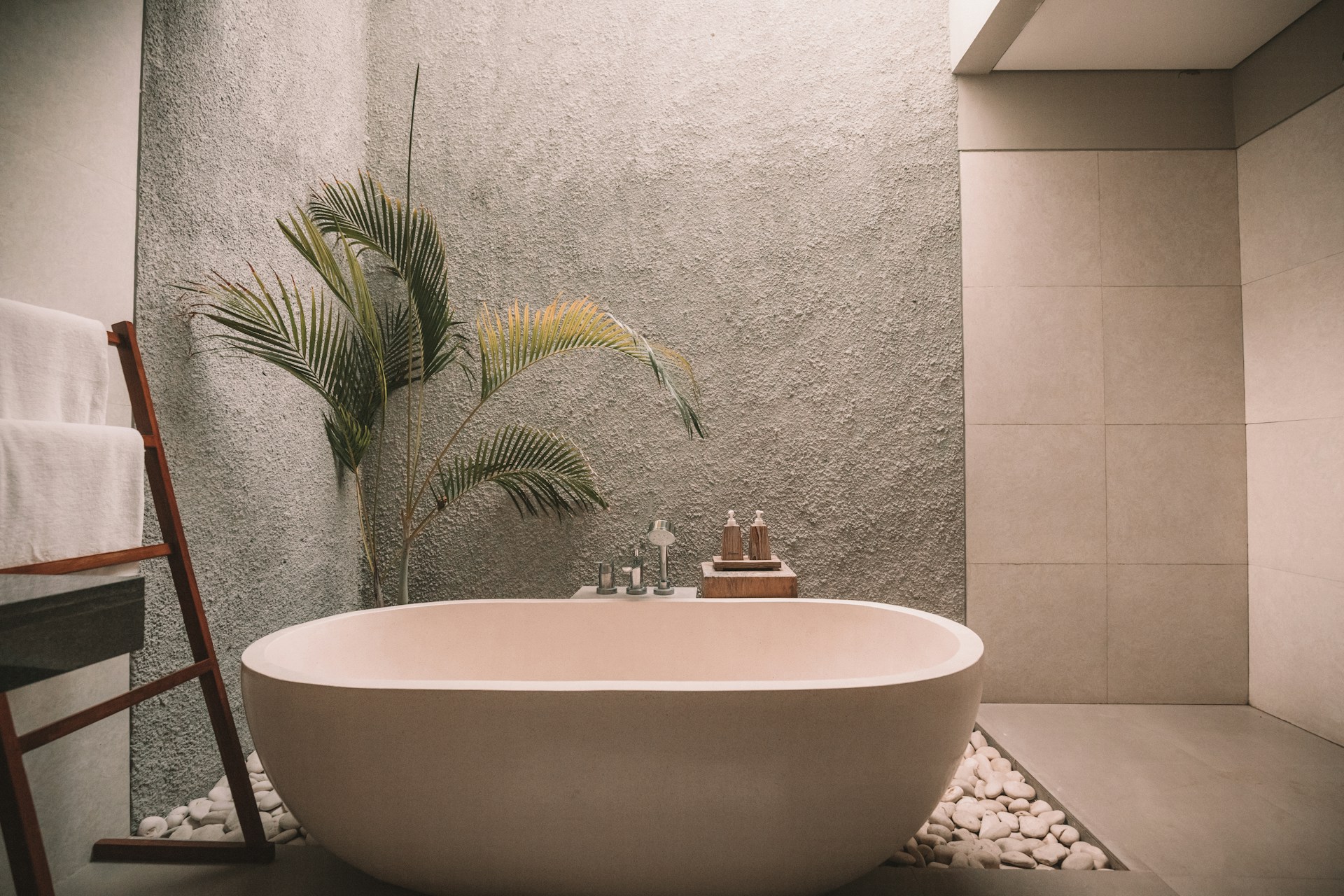
Hidden accent lighting is one of the most useful bathroom trends because it solves both style and safety. LED strips under floating vanities, inside wall niches, behind mirrors, below toe kicks, or under open shelving can add depth without glare.
The key is restraint. Bathroom accent light should be soft, indirect, and easy to clean around. A visible strip stuck to the front edge of a vanity usually looks unfinished. A hidden strip tucked behind a lip, protected by a channel, and dimmed low can look built in.
Night lighting deserves special attention. Nobody wants full vanity brightness at 2 a.m. A low toe-kick strip, motion-triggered under-vanity light, or dim wall sconce can make the bathroom safe without waking the whole room. Keep the color warm and the brightness low. The goal is navigation, not grooming.
If you are using strips in wet or splash-prone areas, check ratings carefully. Our [waterproof LED strip lights guide](/blog/waterproof-led-strip-lights-indoor-outdoor-guide) explains where waterproofing helps and where a dry-room strip in a protected channel is the better choice.
Mistakes to avoid in 2026 bathroom lighting {#mistakes}
The first mistake is using one overhead light as the whole plan. It may make the floor bright, but it rarely flatters faces. Add vanity lighting before chasing decorative trends.
The second mistake is choosing a mirror fixture by looks only. A beautiful fixture with exposed bulbs, glare, poor diffusion, or the wrong color temperature can make daily grooming worse. Test brightness and shadow pattern, not just style.
The third mistake is mixing random Kelvin values. A 2700K vanity light, 5000K ceiling light, and blue-white mirror strip will make the bathroom feel patched together. Use a clear temperature plan by zone.
The fourth mistake is ignoring moisture ratings. Bathroom lights live near steam, splashes, condensation, and frequent cleaning. Use appropriately rated fixtures and follow local electrical code, especially in showers and tub zones.
The fifth mistake is overdoing smart color effects. Smart controls are useful for dimming, schedules, and nighttime scenes. Saturated color can be fun, but it should not replace accurate white light at the vanity.
A practical bathroom lighting checklist {#buying-checklist}
Before buying fixtures or LED strips, check these details:
- Use vertical sconces or a wide mirror fixture for even face lighting.
- Choose 3000K to 3500K around the vanity.
- Choose CRI 90+ for mirror and makeup zones.
- Put ceiling and vanity lights on separate switches or dimmers.
- Use shower-rated fixtures in wet zones.
- Add a low warm night-light layer if the bathroom is used after bedtime.
- Hide LED strips behind lips, channels, mirrors, shelves, or toe kicks.
- Keep drivers and power supplies accessible and ventilated.
- Match fixture finish to hardware, but choose the light effect first.
- Test brightness at night before installing every fixture permanently.
The best bathroom lighting trend is not a single fixture style. It is a more useful hierarchy: accurate light for faces, bright light when needed, softer light for evening, and low light for safe movement at night.
FAQ {#faq}
What are the biggest bathroom lighting trends for 2026?
The biggest trends are layered vanity and ceiling lighting, vertical sconces, backlit mirrors used as accents, warm low-level night lights, hidden LED strips, dimming, and better CRI for grooming.
What color temperature is best for bathroom lighting?
Use 3000K to 3500K for most bathroom vanity lighting. Use 2700K to 3000K for warm evening or bath lighting, and 3500K to 4000K for utility-style bathrooms or shower task light.
Are backlit mirrors enough for bathroom lighting?
Sometimes, but often not. Many backlit mirrors create attractive wall glow without projecting enough light onto the face. Pair them with side sconces or a front-facing mirror light when grooming accuracy matters.
Should bathroom lights be dimmable?
Yes. Dimming lets one bathroom support cleaning, grooming, showers, evening routines, and nighttime use. Put vanity and ceiling lights on separate controls when possible.
Can LED strips be used in bathrooms?
Yes, if they are placed correctly and rated for the exposure. Use protected channels, keep power supplies accessible, and choose wet-rated products for splash-prone or shower-adjacent areas.
Frequently Asked Questions
What are the biggest bathroom lighting trends for 2026?
Layered vanity and ceiling lighting, vertical sconces, backlit mirrors used as accents, warm low-level night lights, hidden LED strips, dimming, and better CRI are the strongest trends.
What color temperature is best for bathroom lighting?
Use 3000K to 3500K for most vanity lighting, 2700K to 3000K for warm evening or bath light, and 3500K to 4000K for utility-style bathroom task light.
Are backlit mirrors enough for bathroom lighting?
Often not. Many backlit mirrors create attractive wall glow but need side sconces or front-facing light for accurate grooming.


